On this page
Overview
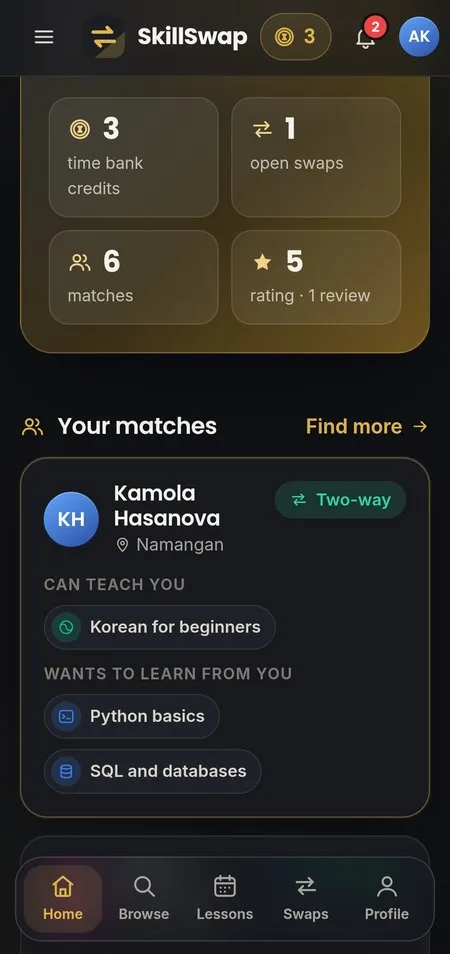
SkillSwap is a skill exchange for students. A member lists a practical skill they can teach, says what they want to learn, and is matched with people who fit. Lessons last an hour and are paid in time-bank credits instead of money: teaching an hour earns one credit, learning an hour spends one.
There are two clients, a mobile-first website and a native Android app. They share one server and one database, so an account, a booking or a review made on one appears on the other.
It began as a university course project (a database-backed website for a Big Data course) and was extended for a university hackathon. Both were registered as team entries, but I designed and built the product myself. This page is about the product and how it is built, not about the competition.
Problem
Students know useful things that other students want to learn, such as a language, a tool or an instrument. Paid tutoring prices many of them out, and informal favours are hard to arrange and easy to abandon. SkillSwap tests a simple idea: if time is the currency, anyone who can teach something can afford to learn something.
Solution
- Time bank. One hour taught is one credit earned. Every change is written to a credit ledger.
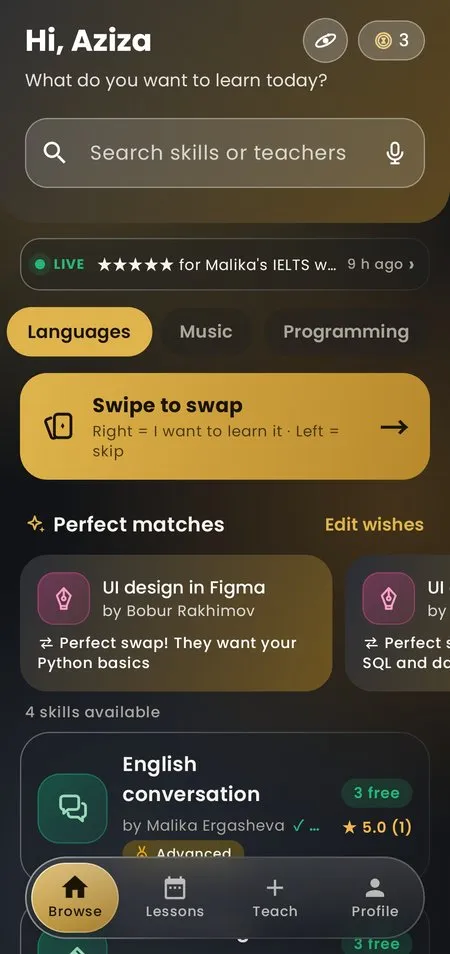
- Matching. Search by skill, category or city. Two-way matches, where each person can teach the other, come first.
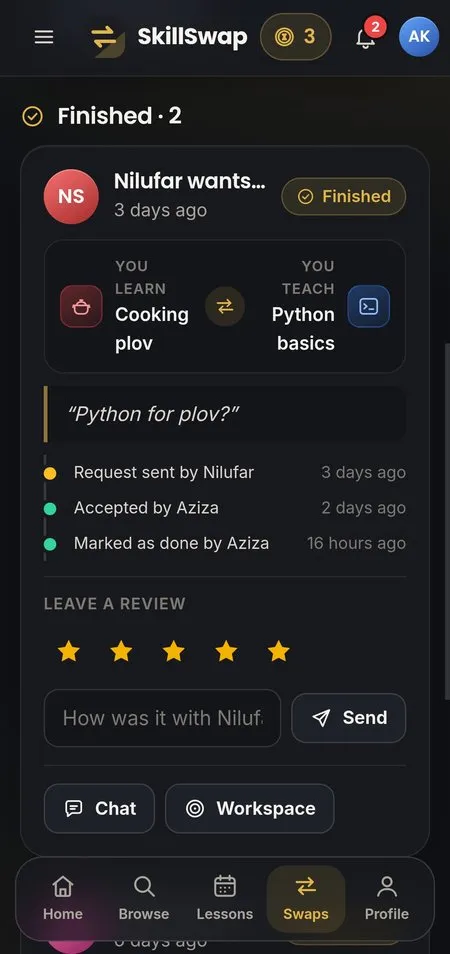
- Swaps and lessons. A direct swap (my skill for yours) has its own request flow and status history. A lesson is a one-hour slot booked with a credit.
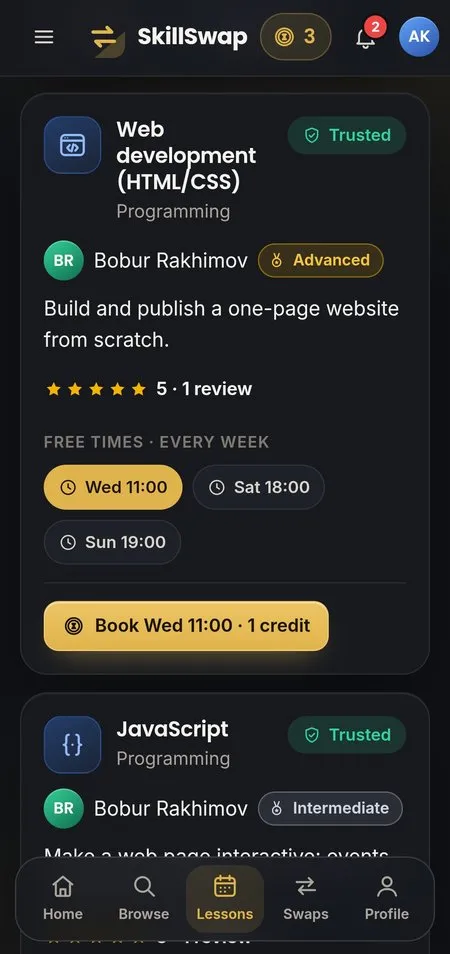
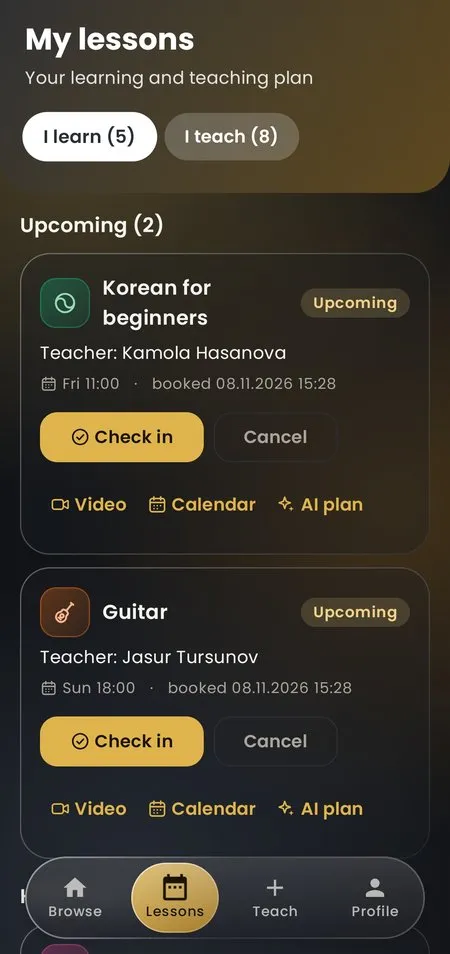
- Trust. A lesson only counts once the learner enters the teacher’s 4-digit check-in code (shown as a QR code in the app). Only a finished lesson can be rated, and only once.
- Meeting. Lessons can happen in person or in a video room built into the product.
Product experience
These journeys are covered by the website’s automated API tests or are visible in the shipped screens:
- Join. Register with email and password, or continue with Google or Telegram. Set a name, city, bio, time zone and weekly availability.
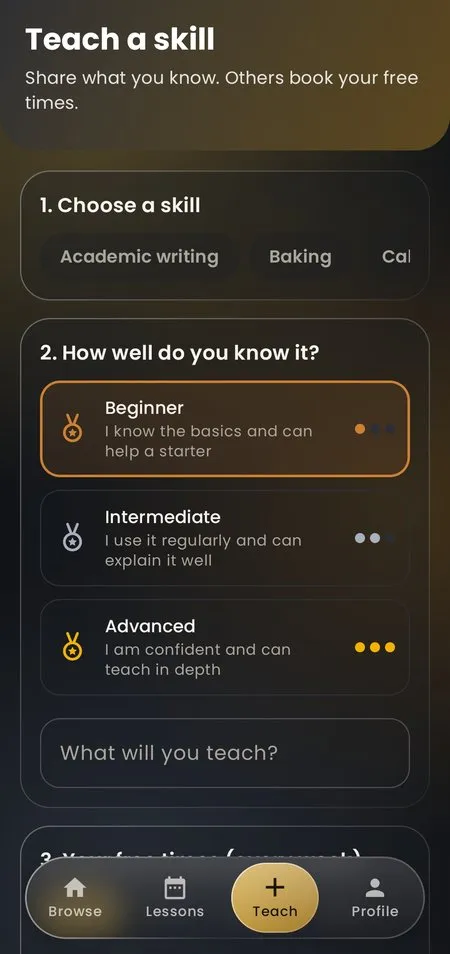
- Say what you offer and what you want. Add skills from a shared catalogue in both directions.
- Find someone. Browse and search. On Android, swipe through a card deck, where a two-way match shows “It’s a swap!”.
- Swap. Send a request. It can be accepted, declined, cancelled or marked done, and each change is logged. After a completed swap each side can leave one review.
- Book a lesson. Teachers publish free slots. A learner books one for a credit, checks in with the teacher’s code, meets in person or by video, and rates the lesson.
- Stay in touch. Messages, notifications and a learning workspace with milestones. Credits and notifications update live.
Technical architecture
How the two clients stay in sync
Both clients use the same accounts and the same sessions table. The website sends the token in an httpOnly cookie, and the app sends it as a bearer header. The app downloads a full snapshot (GET /api/mobile/sync) and writes it to Room in one transaction. Every change goes to the server first, then the app syncs again. Server-sent events tell the app when something changed.
Implementation
Website
Plain HTML, CSS and JavaScript pages served as static files by the same Express process, with no front-end framework and self-hosted fonts and icons. A strict Content-Security-Policy (default-src 'self') is possible because nothing loads from a third party.
Backend
A single Express server exposes 80 routes. 79 of them are under /api, and 34 of those are under /api/mobile for the app. Every input is validated on the server and every query is parameterised. Live updates (credits, notifications, the activity feed) use server-sent events. Video lessons use WebRTC: media goes directly between the two devices, while the server only relays the connection messages and hands out short-lived TURN credentials.
Database
PostgreSQL hosted on Supabase and reached with the standard pg driver over TLS with certificate checking. The schema has 27 tables: a base schema plus 11 SQL migrations that run automatically when the server starts. Booking is a single transaction that locks the slot row (SELECT … FOR UPDATE), so two phones can never book the same hour.
Android
Compose screens read state from a ViewModel (StateFlow), which goes through a repository to a Room cache of 7 entities. The network layer uses Android’s built-in HttpURLConnection and org.json, with no extra networking library. The session token is encrypted with AES-GCM using a key in the Android Keystore. Video calls are driven by a pure state machine (CallMachine) with a foreground service, so a call survives rotation and the app going to the background. The interface is available in English, Uzbek and Russian.
Technology
| Area | Used |
|---|---|
| Web front end | HTML, CSS, vanilla JavaScript, server-sent events, WebRTC (browser) |
| Backend | Node.js 20+, Express 4, bcrypt, pg, google-auth-library, Telegram Bot API |
| Android | Kotlin, Jetpack Compose (Material 3), Navigation Compose, Room, coroutines, Stream’s WebRTC build, Android Keystore |
| Data and hosting | PostgreSQL on Supabase, Render (free tier), optional MongoDB Atlas, Cloudflare TURN |
| Testing | Node’s built-in test runner (80 API and rules tests), optional Playwright browser check, JUnit (66 Android unit tests, counted but not run for this page), GitHub Actions build for the app |
My contribution
I designed and directed the development of SkillSwap from scratch, covering the website, server, database and Android application.
SkillSwap was registered as a team project for a university subject and for a hackathon. That arrangement was for academic and hackathon participation, not shared implementation.
I used AI-assisted coding tools throughout implementation. The repositories preserve the development history and commit attribution.
Challenges and lessons
- One backend, two kinds of client. A browser and a phone authenticate differently. Keeping one
sessionstable and accepting the token as either a cookie or a bearer header avoided two parallel auth systems. - Correctness under concurrency. Double booking is a real risk when two people tap at once. The fix is in the database: a transaction with a row lock, not a check in the app.
- Offline cache vs one source of truth. The app started with a local-first cache, then moved to “online-only, with Room as a read cache” so the server stays the single source of truth. The trade-off is that the app needs a connection.
- Video behind proxies. WebRTC needs signalling and NAT traversal. Signalling runs over plain HTTPS (server-sent events plus small POSTs), so it passes through Render’s proxy. TURN credentials are requested for each room and expire after a few hours, so the long-term key never leaves the server. A “renegotiate” signal handles network changes.
- Ordinary phones. Several commits deal with smooth scrolling, avoiding needless redraws during live sync, and animations that respect the phone’s animation-scale setting.
Current status
Each line says what was checked, and how. “Tested” means I ran the website’s own test suite on 22 Nov 2026 against a fresh PostgreSQL 16 database. “Not verified” means I have no evidence either way.
| Area | Status | Basis |
|---|---|---|
| Website features: accounts, profiles, skills, matching, swaps and reviews, lessons and the time bank, check-in, chat, notifications, mobile API, video-room access rules, Google and Telegram sign-in | Working, tested | 80 of 80 automated tests passed |
| Live deployment on Render | Not verified | Documented as deployed on Render’s free tier with the database on Supabase. I could not reach it from my test environment, so I have not checked it |
| Android app | Not verified | Documented in the repository as working against the same backend. Not built or run for this page. 66 unit tests exist; counted, not run |
| Video lessons | Partial | Needs TURN configured on the server |
| AI matchmaker | Partial | Falls back to keyword matching without an API key |
| MongoDB statistics | Optional | Not needed for the core product |
| Email verification and password reset | Not done | Not in the code |
| Login rate limiting | Not done | Only chat and video signalling are rate-limited |
| Hosting | Limitation | The free tier sleeps when idle, so the first request can take up to a minute |
All accounts and records in the demo are fictional. There are no real users.
Future direction
- Rate-limit login and registration, then add email verification and password reset.
- Replace the full-snapshot sync with incremental changes, so the app moves less data as the community grows.
- Move hosting off a sleeping free tier before inviting real students.
- Run a small pilot with real students and measure whether credits actually circulate.